Solar Panel Price in Delhi with Subsidy (2026): Real Cost of 1 kW to 5 kW
Ask three vendors the solar panel price in Delhi and you'll get three numbers, sometimes forty thousand rupees apart. Same roof. Same city. Teeno bolenge "best price sir."
Confusing? Haan. Random? No. The gap always has reasons, and once you know them, no quote can surprise you. That's what this post is for.
I run Solar Suvidha, and price is the first question in almost every WhatsApp chat we get. So here are the real 2026 numbers, the way I explain them to homeowners, minus the sales polish.
Solar panel price in Delhi, size by size
The honest table. Every figure is a range because brand, roof and vendor change things, and every subsidy figure is "up to" because approvals decide the final amount.
| System | Price before subsidy | Subsidy (central + Delhi) | What you roughly pay |
|---|---|---|---|
| 1 kW | Rs 75,000 to 95,000 | up to Rs 40,000 | Rs 35,000 to 55,000 |
| 2 kW | Rs 1.4 to 1.7 lakh | up to Rs 80,000 | Rs 60,000 to 90,000 |
| 3 kW | Rs 1.8 to 2.4 lakh | up to Rs 1,08,000 | Rs 1 to 1.3 lakh |
| 5 kW | Rs 2.8 to 3.6 lakh | still capped at Rs 1,08,000 | Rs 1.7 to 2.5 lakh |
Notice the 5 kW row. Subsidy per kW is highest till 3 kW, then it stops growing. That's why 3 kW is the sweet spot for most Delhi homes, and why every vendor keeps pushing it. For once, the sales pitch and the maths agree.
Ek zaroori baat about how the money moves
Nobody tells people this clearly, and it causes real stress in month two. Now you know.
What is actually inside a solar quote
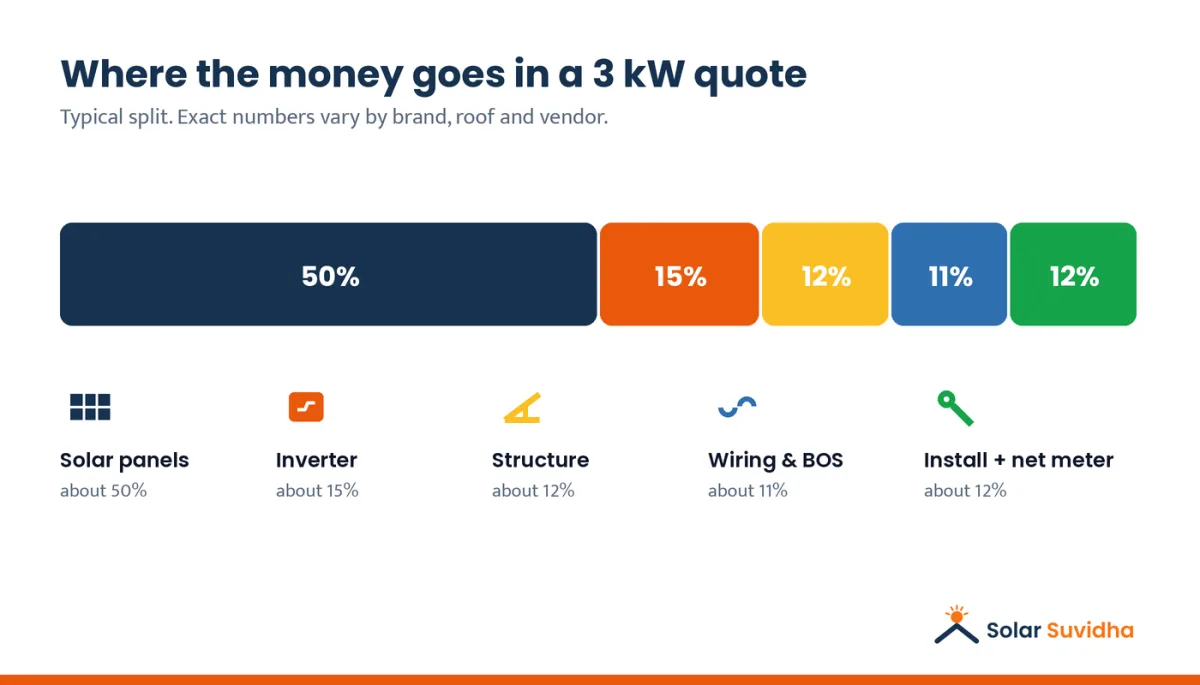
Roughly, a 3 kW quote splits like this: solar panels take the biggest share, around half the cost. Then the inverter. Then the mounting structure, wiring and balance of system, and finally installation labour plus the net metering work. Two quotes differ mainly because of three things:
- Panel brand and type. ALMM-listed DCR panels from names like Waaree, Tata or Adani cost more than unknown imports. Newer TOPCon panels cost more than older tech, and generate more.
- Inverter quality. The inverter works the hardest and fails the first. A good brand here is money well spent.
- Structure height. A raised structure (so you can still use the roof underneath) adds ten to twenty thousand versus a flat one.
And one thing you already know if you read our PM Surya Ghar application guide: panels that are not ALMM-listed don't just perform worse. They can cancel your entire subsidy.
Sasta quote hamesha kahin na kahin se sasta hota hai. Panel se, inverter se, ya aapki subsidy se.
The charges people forget to ask about
These small lines change the final solar panel cost in Delhi more than people expect. Before you sign, ask whether the quote includes:
- Net meter charges and the DISCOM application work
- Meter security deposit, if your DISCOM asks for one
- Elevated structure, if that's what your roof needs
- First year service and cleaning
"Sab included hai sir" is an answer. Get it in writing on the quotation.
What a 3 kW system gives back in Delhi
Now the fun side. A 3 kW setup in Delhi generates around 12 to 15 units a day, call it 350 to 400 units a month. Two ways that turns into money:
- Your bill drops. At Delhi tariffs of Rs 7 to 9 per unit in the higher slabs, those units are worth Rs 2,500 to 3,500 every month.
- Delhi pays you to generate. The state's GBI gives Rs 3 per unit for five years on systems up to 3 kW. Around Rs 900 a month. Roughly Rs 54,000 over five years, for doing nothing extra.
Put it together and the real solar panel price in Delhi is not the invoice, it's the invoice minus everything the system pays back. Payback lands around 3 to 4 years for a typical home. After that, it's 20 plus years of mostly free power. Panels degrade slowly, bills don't.
The 400 unit twist
If your monthly usage crosses 400 units, Delhi gives you no subsidy on your electricity bill. Every unit you buy is full price. Which means every unit your roof produces saves full price too. Highest bills, fastest payback. Zindagi mein kahin toh high bill kaam aaya.
So what should you actually do
Not "buy the cheapest." Not "buy the costliest and hope." Do this:
- Check what your roof and usage qualify for. Two minutes, free, on our eligibility check.
- Get two or three quotes from registered vendors only, itemised.
- Compare panel brand, inverter brand, structure type and what's included, not just the bottom line.
- Confirm the ALMM listing before you say yes to anything.
The solar panel price in Delhi has never been this reasonable, and the subsidy stack has never been this big. The only expensive mistake left is choosing blind. Ab aap blind nahin ho.
Free eligibility check
Is your roof eligible for the ₹1,08,000 subsidy?
Two minutes, honest numbers, one verified installer. Free for homeowners.